1570 nm single-aperture laser rangefinder
One shared optical aperture. An integrated 1570 nm ranging solution with a specified mass of ≤2.9 kg, beam divergence of ≤0.4 mrad and an RS422 interface.
Explore specifications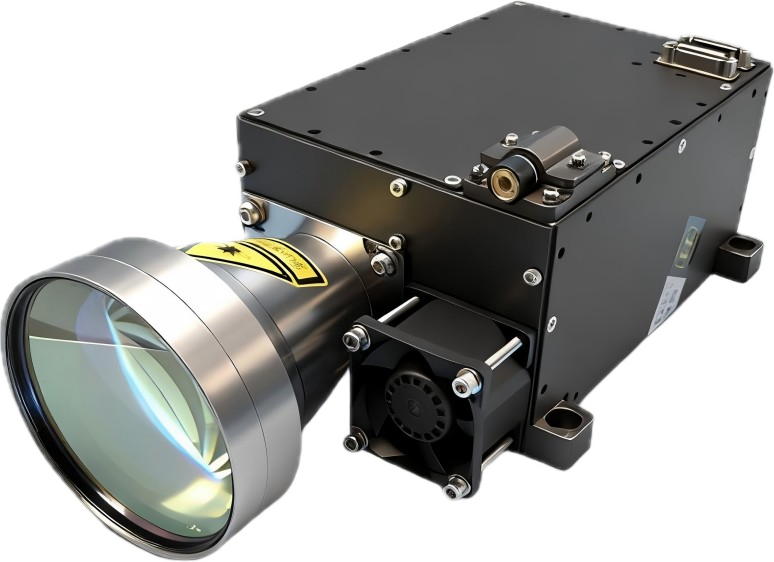
Long-range measurement.
One shared aperture.
Transmit and receive paths share a single external objective. The integrated design brings the optical interface, housing and RS422 communication together for system evaluation.
A specified mass of no more than 2.9 kg and beam divergence of no more than 0.4 mrad give engineering teams a clear starting point for a long-range measurement project.
A specified range beyond 60 km.
Specified for 80 km visibility, a 10 × 10 m object and reflectivity above 20%. Actual range depends on the object and measurement conditions.
Key specifications
- Wavelength
- 1570 ±5 nm
- Maximum range
- >60 km with 80 km visibility, a 10 × 10 m object and reflectivity above 20%
- Minimum range
- 300 m
- Ranging accuracy
- ≤5 m
- Mass
- ≤2.9 kg
- Beam divergence
- ≤0.4 mrad
- Ranging rate
- 1–25 Hz
- Single-ranging response time
- 1 s
- Communication
- RS422, full duplex, 115200 bps
Operating cycle: 60 s operation followed by 60 s rest; four cycles at ambient or low temperature and four cycles at 60°C. Ranging rate and valid-data rate are separate requirements and should be assessed for the intended operating mode.
Beam-divergence convention, mechanical fit, power limits, protocol revision and laser-safety classification are reviewed for the project configuration.
Define the measurement.
Then the configuration.
Large objects and long baselines
Discuss distance measurement for large structures and extended objects. Object dimensions, surface reflectivity and atmospheric visibility establish the starting point for a range assessment.
Optical instrument integration
Evaluate a ranging channel alongside your imaging or observation equipment. Bring the interface, mounting, cooling and alignment requirements into the same conversation.
Research and field evaluation
Set the required distance, accuracy and valid-data rate together. A clear acceptance plan connects published specifications to your test conditions.
Tell us what you need to measure
Share your required distance, nearest measurement, object size and site conditions. Add your size, weight, power and interface limits so we can discuss the relevant configuration and engineering documents.
Discuss this product