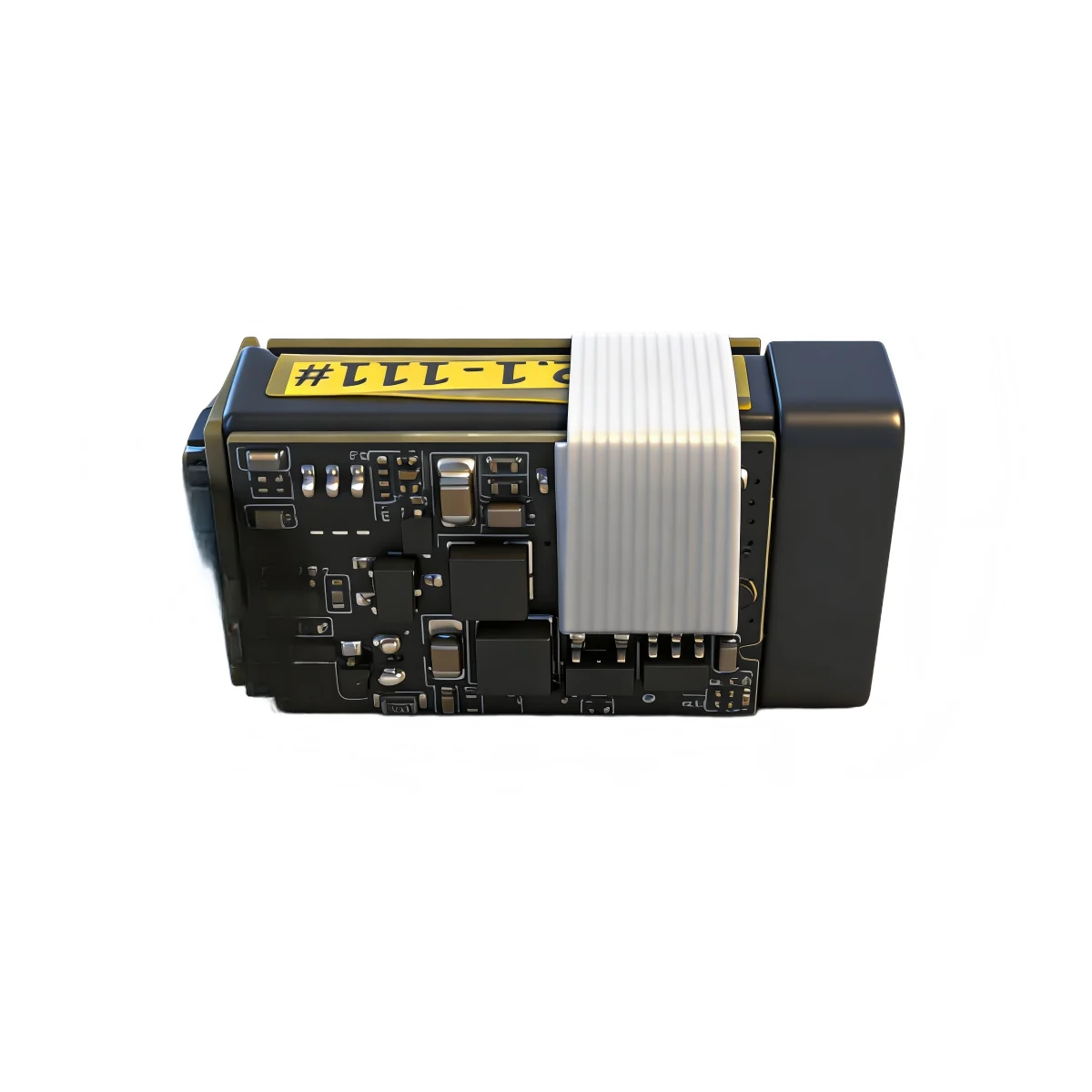
Two rangefinders can publish the same maximum range and behave differently on the same target. Beam divergence is one reason. A narrow beam puts more light on a small target; a wide beam is easier to aim but spends light on the background. The spot at the target is the number that connects the datasheet to the installation.
The geometry
Beam divergence is the angle at which the beam spreads after it leaves the module. For a small angle, the diameter of the spot at distance R is approximately:
spot diameter ≈ R × θ
where θ is the divergence in radians. A 4.5 mrad beam at 100 m gives a spot about 0.45 m across. A 10 mrad beam at the same distance gives about 1.0 m. The exact profile depends on the emitter, the collimating optics and the aperture; the formula is a planning estimate, not a measured beam map.
Published divergence, calculated spot
The table uses the divergence published on the ERDI model record and calculates the spot diameter at three distances. It is a comparison aid, not a substitute for a target test.
| Model | Published divergence | Calculated spot at 10 m | At 100 m | At 500 m |
|---|---|---|---|---|
| LRF0815C | ≤0.3 mrad | 0.3 cm | 3 cm | 15 cm |
| LR1200E2 | <4 mrad | 4 cm | 40 cm | 200 cm |
| SPD1200N2 | <4.5 mrad | 4.5 cm | 45 cm | 225 cm |
| LR1500E2 | <6 mrad | 6 cm | 60 cm | 300 cm |
| SPD1200Z2 | <6 mrad | 6 cm | 60 cm | 300 cm |
| LR1000E2 | <9 mrad | 9 cm | 90 cm | 450 cm |
| LRF3000A1 | ≤10 mrad | 10 cm | 100 cm | 500 cm |
These are calculated values from the published divergence. A real beam is not a perfect circle, and the effective spot can be larger than the geometric estimate. Use the table to screen models, then test the shortlisted module on the actual target.
Why the spot matters
Small targets. If the target is smaller than the spot, part of the return comes from the background. The receiver may report the stronger return, an average, or a no-return. A narrow beam reduces that risk, but it also makes the module harder to aim.
Edges and slopes. A beam that straddles an edge can return two distances. A sloped surface can send the return away from the receiver. The spot size and the surface angle both matter; divergence alone does not predict the result.
Energy density. A narrow beam concentrates the same optical energy into a smaller area. That can improve the signal from a small target, and it also changes the optical safety analysis. The classification of a finished product depends on the complete optical path and operating conditions, not on the divergence number alone.
Alignment. A wide beam tolerates mechanical misalignment; a narrow beam does not. If the module is mounted on a moving platform, the beam angle and the mounting tolerance are part of the design.
What to ask before choosing
- Is the published divergence a full angle or a half angle? The difference is a factor of two.
- Is the figure a typical value or a maximum? A maximum is more useful for a tolerance stack.
- What is the beam profile at the working distance? A Gaussian beam and a clipped beam do not have the same effective spot.
- What is the target size at range, and what happens when the spot is larger than the target?
- What is the receiver aperture? A larger aperture can collect more return from a wide spot, but it also sees more background.
For the optics background, see RP Photonics on beam divergence. For the ERDI model records, see erdilrf.com/models. Send the target size, working distance and mounting tolerance to https://erdilrf.com/contact/; we will compare the published divergence with the spot your target can accept.