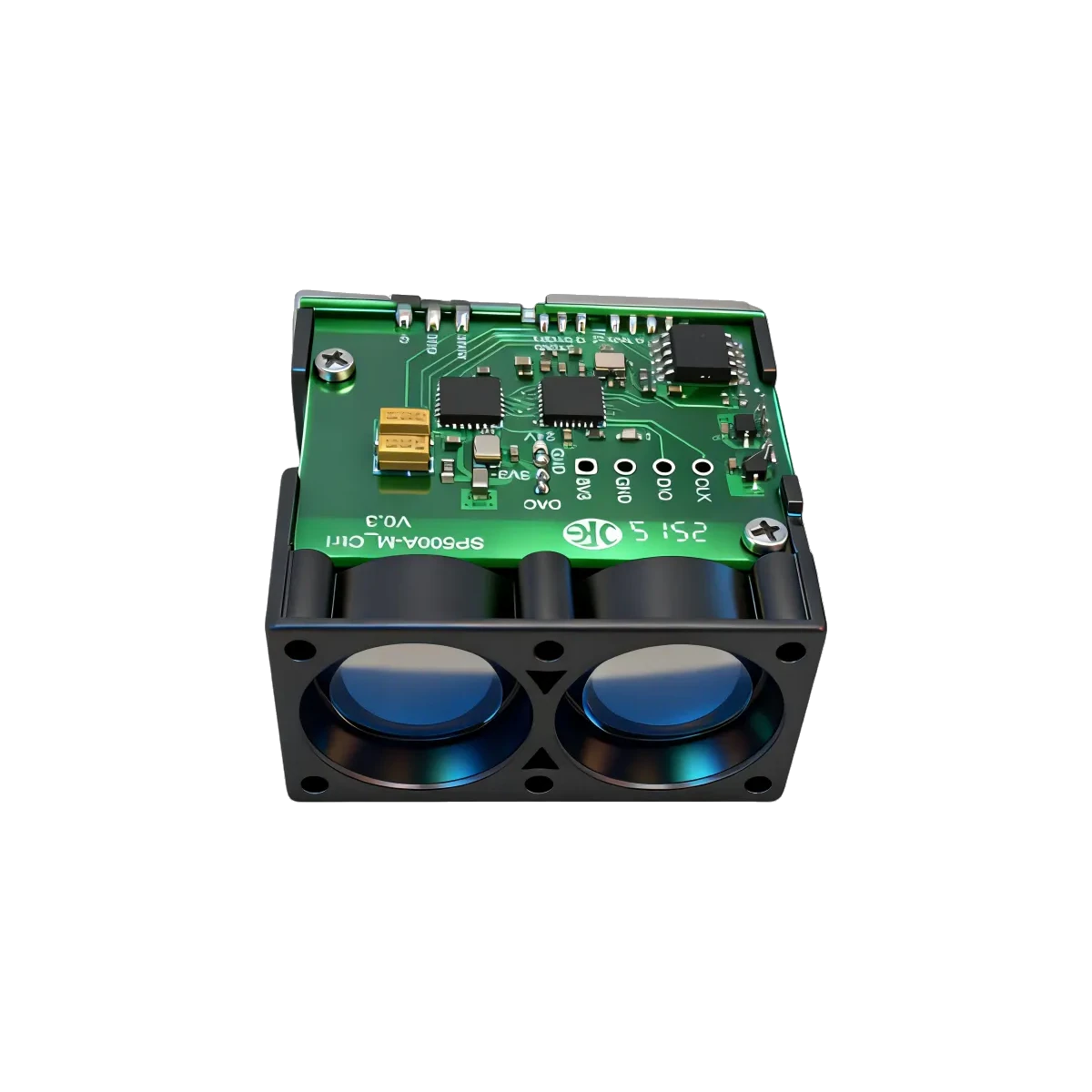
Benewake and ERDI both appear on UAV and robotics supplier lists. The comparison is useful only when the range class is clear. Benewake’s TF series is known for compact short-range lidar for altitude and obstacle sensing. ERDI’s catalogue spans short-range dToF, 905 nm modules in the 50-1,500 m class and a 3,000 m target condition. They overlap at the close end, not across the whole range.
What Benewake is known for
Benewake publishes the TF series and related lidar products for drones, robots and industrial sensing. The public product pages are the authority for range, interface, field of view and update rate: en.benewake.com. The family is widely used where a small, low-power distance sensor is needed at short range.
If your requirement is a few metres to a few tens of metres, a cooperative target and a high-volume, cost-sensitive build, a TF-series sensor may be the practical starting point. The integration is well documented and the modules are small.
Where ERDI fits
ERDI’s SPD series covers short-range dToF with 905 nm sources. The H series covers 0.05-1,500 m with UART or I²C, and the LR series covers 4-1,000 m and 4-1,200 m in UART-TTL modules. The LRF3000A1 publishes a 3,000 m target condition at 70% reflectivity. The model pages state the target conditions and the lower-reflectance range where the source provides it.
The overlap is at the short end. The difference becomes material when the target is dark, the distance is beyond the short-range class, or the host needs a documented protocol and a specific supply range. At that point the comparison moves from module size to optical budget and interface detail.
A practical comparison
| Question | Benewake TF-class | ERDI module class |
|---|---|---|
| Close-range altitude / obstacle sensing | Small, low power, widely used | SPD/H series can fit; check whether the extra range is needed |
| 50-300 m ranging | Outside the usual short-range class | H series, UART or I²C |
| 500-1,500 m OEM integration | Not the target class | LRF1500H / LR1200E2 |
| 3,000 m target condition | Not the target class | LRF3000A1, 70% reflectivity condition |
| Dark or tilted target | Check the published lower-reflectance range and field of view | Check the model record’s lower-reflectance range and divergence |
| Published starting price | Ask Benewake for the current model and quantity | Published on each ERDI model page; exact quote in writing |
What to verify before choosing
Range condition. A short-range lidar may be specified for a cooperative target. A longer-range module should publish a lower-reflectance figure. Compare the figure that matches your target, not the largest number in the table.
Field of view and spot size. A wide field of view is useful for obstacle detection and less useful for a small target at range. Check the divergence and the spot at the working distance.
Interface and logic level. UART and I²C are not enough information. Confirm the logic level, the connector and the protocol frame. A module that needs a 5 V host is not a drop-in replacement for a 3.3 V host.
Update rate. Check completed outputs per second. The optical pulse rate is not the same number.
Environment. A bare module inside a pod and an exposed sensor on a wet deck need different sealing and window design.
When ERDI is not the answer
If the requirement is a few metres, a high-volume consumer build and a very small package, a TF-class sensor may be the better fit. If the design is already qualified around a specific Benewake protocol and field of view, changing it may cost more than it saves. If you need a fully sealed instrument, neither bare module is finished; the host enclosure still has to be designed and tested.
ERDI is a fit when the distance moves into the 50-1,500 m class, the host can use UART or I²C, and a published model record with target conditions is useful. The catalogue is at erdilrf.com/models. Send the target, distance and host to https://erdilrf.com/contact/ and we will answer with the model that fits, or say when a short-range sensor is the better choice.