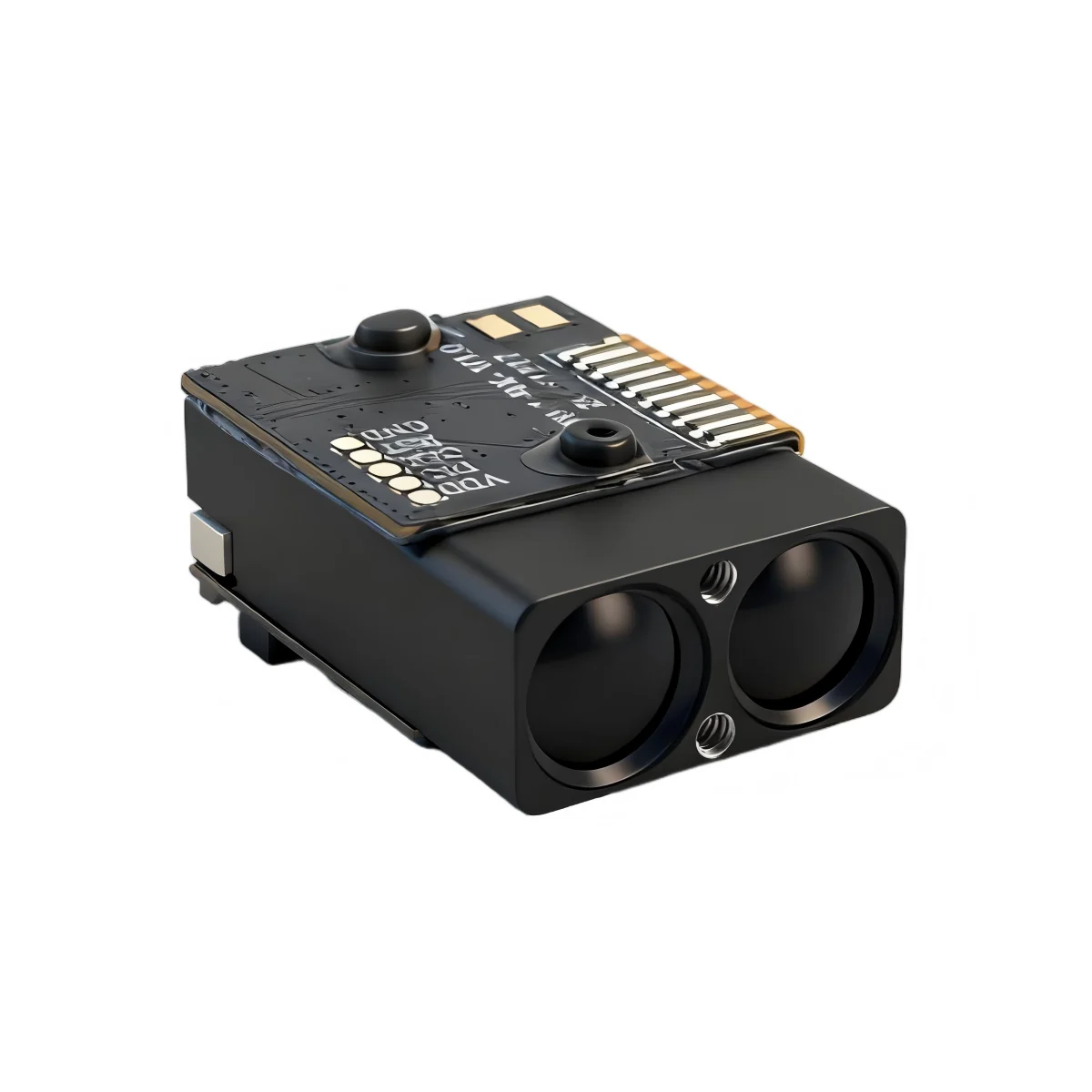
TeraRanger and ERDI are usually compared because both appear in UAV and robotics integration lists. They are not the same class of sensor. TeraRanger is a family of short-range time-of-flight sensors from Terabee. ERDI’s catalogue is built around laser rangefinder modules that extend from short-range dToF to 1,500 m and 3,000 m target conditions. The right comparison starts with the distance you actually need.
What TeraRanger is for
TeraRanger sensors are small, light time-of-flight modules used for close-range altitude, obstacle detection and positioning. Their value is in a compact package, a fast update and an interface that a flight controller or companion computer can read. Terabee publishes the current product family and specifications on its site: terabee.com.
If your working distance is a few metres to a few tens of metres, and the target is cooperative, a short-range ToF sensor is often the simpler choice. The optics are small, the power is low and the integration is well documented.
Where ERDI sits
ERDI’s short-range dToF models, such as the SPD1200N2 and SPD1200Z2, cover the close-in end with a 905 nm source and a published divergence figure. The H series moves into the 50-1,500 m class with UART or I²C. The LR series covers 4-1,000 m and 4-1,200 m in UART-TTL modules, and the LRF3000A1 extends the long end to a 3,000 m target condition at 70% reflectivity.
The overlap with TeraRanger is at the short end. The difference becomes clear when the required distance moves beyond the short-range class, or when the target is dark, tilted or small at range. At that point the receiver aperture, the beam divergence and the published lower-reflectance range matter more than the package size.
Choose by the distance and the target
| Integration need | Short-range ToF (TeraRanger class) | ERDI module class |
|---|---|---|
| Close altitude or obstacle sensing | Small, fast, low power; usually the simplest fit | SPD/H series can fit, but check whether the extra range is worth the size and power |
| 50-300 m industrial or UAV ranging | Outside the usual short-range class | H series, with UART or I²C and a published lower-reflectance range |
| 500-1,500 m OEM integration | Not the target class | LRF1500H / LR1200E2, with the target condition stated |
| 3,000 m target condition | Not the target class | LRF3000A1, with the 70% reflectivity condition |
| Very small target at close range | A tight spot and short range can be an advantage | Check divergence and spot size against the target |
The questions that separate them
What is the target at the working distance? A 10 cm target at 3 m and a 2 m target at 300 m are different optical problems. Write the target size and reflectivity before comparing modules.
What is the lower-reflectance range? A short-range sensor may be specified for a cooperative target. A longer-range module should publish the range at a lower reflectivity, not only the best-case figure.
What does the host need? UART, I²C, PWM, CAN or a companion computer. The interface can eliminate a module before the optics are considered.
What is the update requirement? A fast attitude loop and a slow survey task have different needs. Check completed outputs per second, not the optical pulse rate.
What is the environment? A bare module inside a protected pod is a different sealing problem from an exposed sensor on a wet deck.
When either side is the wrong choice
If you need a few metres of altitude on a small drone, a TeraRanger-class sensor is often the right answer. If you need 300 m at 10% reflectivity in daylight, a short-range ToF sensor is not the right tool. If you need a fully sealed instrument, neither bare module is a finished product; the host enclosure still has to be designed and tested.
ERDI’s model records are at erdilrf.com/models. The SPD series is the short-range dToF end; the H and LR series are the longer-range end. Send the distance, target and host to https://erdilrf.com/contact/ and we will point to the model that fits, or say when a short-range sensor is the better choice.