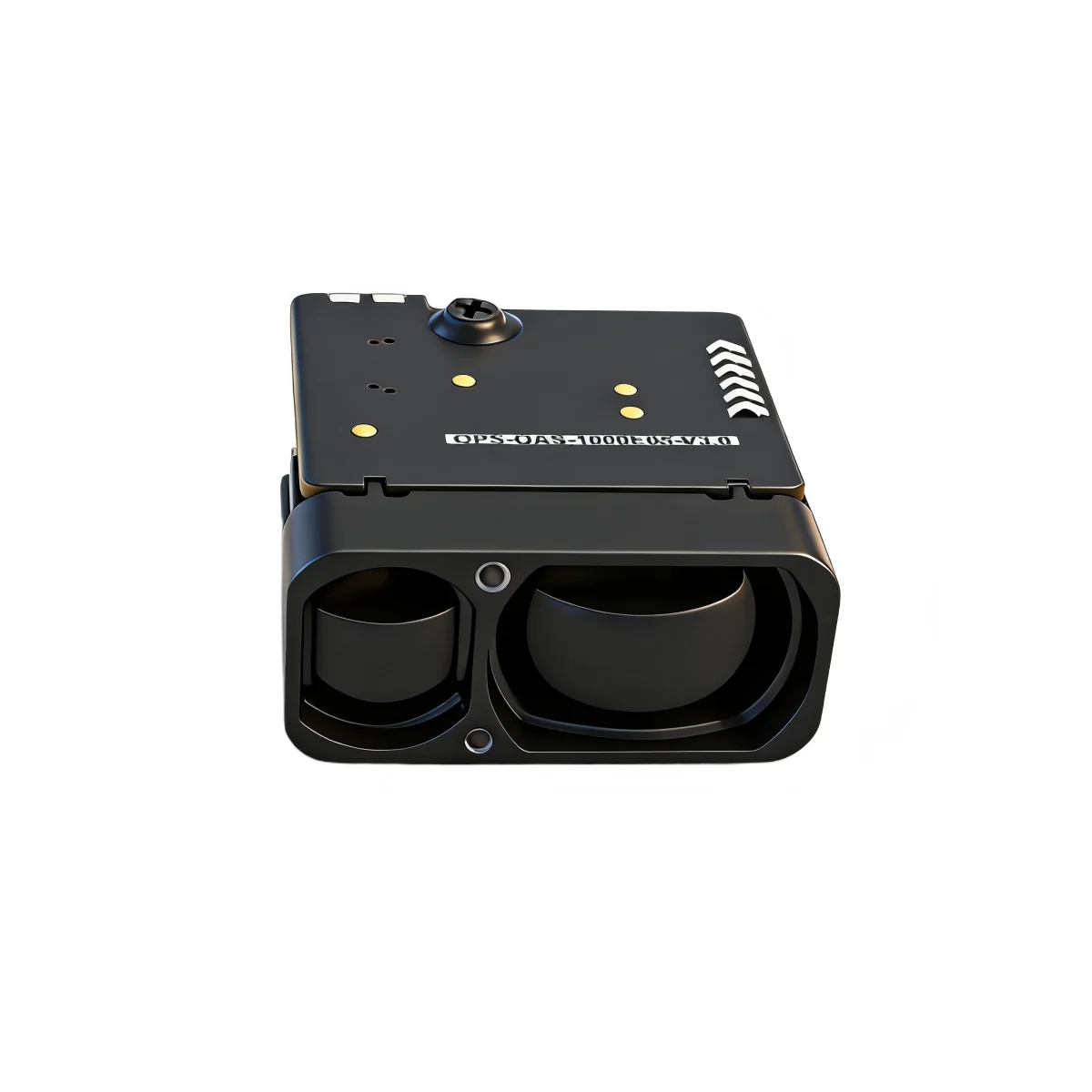
LightWare and ERDI both sell laser rangefinder modules for OEM integration. The overlap is real, but the products are not interchangeable by headline range. A fair comparison starts with the target, the host and the documentation you can actually verify.
What LightWare publishes
LightWare is a South African lidar company with a family of OEM rangefinder modules, including the GRF series. Its public product guide is the authority for range, accuracy, update rate, interface and mechanical data. If you are already using a LightWare module, the useful step is to put the current guide beside the ERDI model record and compare the conditions, not only the largest number.
Public entry point: lightwarelidar.com. The exact GRF model guide should be requested from LightWare or read from its current product page; this article does not repeat numbers that may change with a revision.
What ERDI publishes
ERDI publishes a model record for each module, with the measurement conditions attached to the number. The 905 nm range includes the LR1000E2 at 4-1,000 m and the LR1200E2 at 4-1,200 m, both UART-TTL. The long-range LRF3000A1 publishes a 3,000 m target condition at 70% reflectivity. The H series covers 0.05-1,500 m with UART or I²C, with the lower-reflectance range stated separately. The catalogue pages also carry a published starting price for each model.
The point is not that one record is better. The point is that the record tells you which condition the number belongs to. A 1,200 m figure at 90% reflectivity and a 1,200 m figure at 10% reflectivity describe different products for a real installation.
The dimensions that decide the comparison
| Dimension | Ask LightWare | ERDI model record |
|---|---|---|
| Range at your target reflectivity | The current GRF guide’s range at 90% and at 10% | Each model page states both conditions where published |
| Accuracy at range | The accuracy formula and the target used | Absolute figure plus a distance-dependent term, with the target condition |
| Update rate | Completed outputs per second, not pulse rate | Adaptive or switched rate, stated per model |
| Interface | UART, I²C, connector and logic level | UART-TTL or UART / I²C by model; logic level needs confirmation where not stated |
| Size and mounting | Drawing and optical axis | Model page and drawing where published |
| Ingress rating | What the rating covers | Lens cavity or module; host enclosure is separate |
| Documentation | Current guide revision | Model record, datasheet and protocol notes |
| Sample and lead time | Written quote | Published starting price; exact quote in writing |
Where the decision usually turns
Range versus reflectivity. If the target is dark or the weather is poor, the lower-reflectance number decides. A module with a strong 90% figure but a weak 10% figure may not serve a wet, dark or distant target.
Interface. A UART-only host cannot use an I²C-only module without a bridge. The opposite is also true. Check the logic level, not only the protocol name; a 3.3 V host and a 5 V driver are not a direct connection.
Documentation. A public guide with a revision number is easier to audit than a sales sheet. If the guide does not state the target condition, ask for the test record behind the number.
Sample cost and lead time. A lower starting price is useful only if the sample arrives with the documentation you need. Ask for the sample price, the test report and the production lead time in the same thread.
When ERDI is not the answer
If you need a fully sealed, finished instrument with its own IP rating, a bare module is the wrong starting point. If your platform is already qualified around a specific LightWare form factor and guide revision, changing the module may cost more in re-qualification than it saves. If your range is only a few metres and the target is cooperative, a small triangulation or short-range ToF sensor may be simpler and cheaper.
ERDI is a fit when you need a 905 nm module in the 50-1,500 m class, a published model record, UART or I²C, and a sample that can be tested against a specific target. The catalogue is at erdilrf.com/models.
A comparison you can send to both vendors
- Target: material, colour, reflectivity, size at range, flat or tilted.
- Light: indoor, overcast, direct sun, window and any protective mesh.
- Output: accuracy, repeatability, update rate, oldest acceptable measurement.
- Host: supply, interface, logic level, connector and cable length.
- Environment: temperature, water, dust, vibration and cleaning.
- Commercial: sample quantity, production quantity, destination and Incoterm.
Send that list to https://erdilrf.com/contact/. We will answer with the ERDI model records that fit and the items that still need a bench check. For the LightWare side, ask for the current guide revision and the same list.