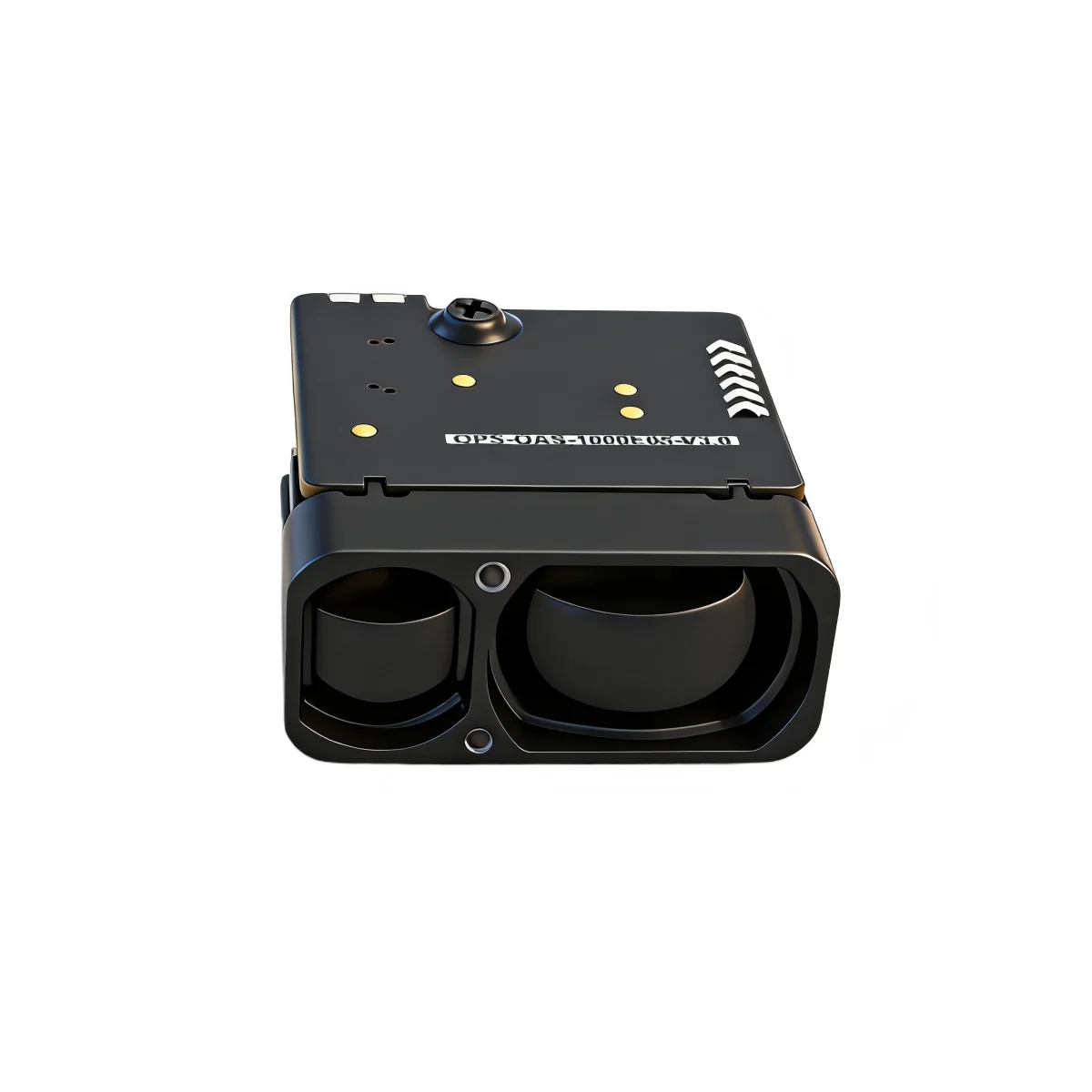
A Lidar-Lite replacement usually starts with a failure or a constraint: the range is too short, the interface no longer fits, the accuracy is not good enough on the real target, or the supply is uncertain. The right alternative depends on which of those is actually true. Swapping one compact lidar for another is not an upgrade if the new module fails at the same condition.
What Lidar-Lite is good at
Garmin’s Lidar-Lite v3 and v3HP are compact OEM lidar modules used in drones, robots and distance-measurement projects. They are known for a small package and a documented interface. Garmin publishes the operation manual and technical specifications; the current manual is the authority for range, accuracy, interface and power:
LIDAR-Lite v3HP operation manual and technical specifications
If the requirement is short range, a cooperative target and a compact module, the Lidar-Lite class may still be the right one. The replacement question is what happens when the target or the range moves outside that class.
Four replacement paths
| Constraint | Path | What to check |
|---|---|---|
| Range is too short | Move to a longer-range laser rangefinder module | Lower-reflectance range, divergence, receiver aperture, update rate |
| Interface no longer fits | Choose a module with the host’s UART or I²C, or add a bridge | Logic level, connector, protocol frame, cable length |
| Accuracy is not enough on the real target | Change the optical class, not only the firmware | Accuracy formula, target reflectivity, spot size at range |
| Supply or lifecycle is the issue | Qualify a second source with the same integration envelope | Drawing, mounting, power, interface and documentation |
What must match before you swap
- Protocol: the frame, the checksum and the request/response behaviour. A different module with the same connector is not a drop-in replacement.
- Address and bus: an I²C address conflict can stop the host before the first measurement.
- Power: average and inrush current, supply range and the effect on the host rail.
- Update rate: completed outputs per second, not the optical pulse rate.
- Field of view and spot: a wider beam is not better for a small target at range.
- Mounting and optical axis: the new module must fit the same window and alignment.
- Environment: the ingress rating of the module and the host enclosure are separate claims.
ERDI models to consider
For a longer-range replacement, the LR1000E2 and LR1200E2 cover 4-1,000 m and 4-1,200 m in UART-TTL modules. The LRF1500H covers 0.05-1,500 m at 90% reflectivity and 0.05-300 m at 10% reflectivity, with UART or I²C. The LRF3000A1 publishes a 3,000 m target condition at 70% reflectivity. For the short end, the SPD1200N2 and SPD1200Z2 are 905 nm dToF modules with published divergence figures.
These are not drop-in replacements for a Lidar-Lite. They are different optical classes with different protocols and power. The model page is the starting point, not the wiring diagram.
When to stay with the Lidar-Lite class
If the target is cooperative, the range is short and the host is already qualified around the Lidar-Lite protocol, a same-class replacement may be the lower-risk path. A longer-range module adds optical and protocol work that may not be justified by the application. The honest answer is sometimes to keep the class and change the supplier, not to change the principle.
Send the current module, the host interface, the target and the failed condition to https://erdilrf.com/contact/. We will say whether an ERDI module is a credible replacement and what would have to change in the host. The catalogue is at erdilrf.com/models.