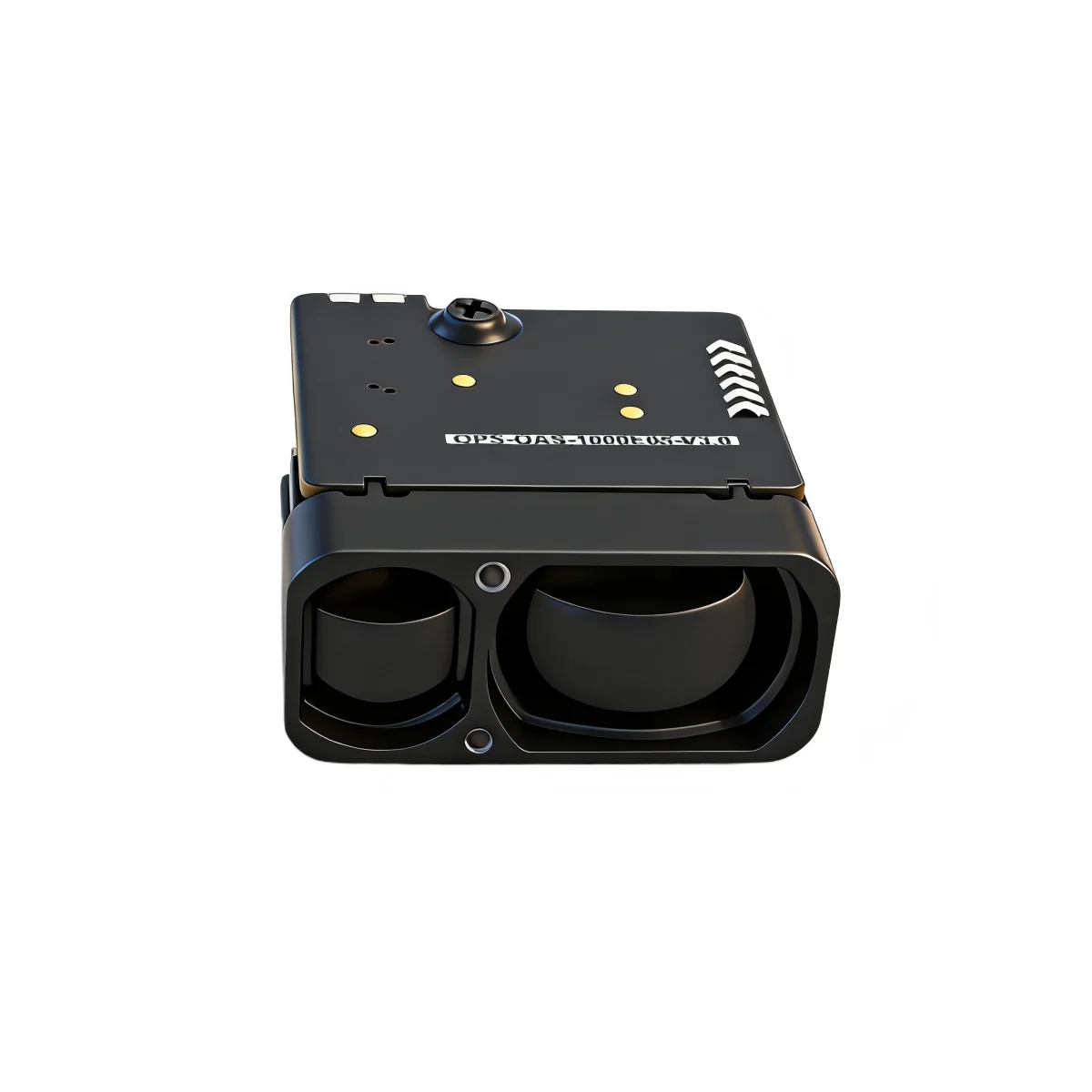
When a listing uses “laser distance module” and “laser rangefinder module” interchangeably, check four rows in the spec table: measuring range with a reflectivity condition, update rate, supply voltage, and baud rate. Those four rows sort every 905 nm time-of-flight module into one of two distinct product classes before the full datasheet arrives.
Why the two names get mixed
Both names describe a module that emits a short laser pulse, times the returning echo, and converts the interval to a distance value. Trading platform catalogs apply both names to any UART laser module because the underlying measurement principle is identical. The confusion is compounded when a supplier translates product names across languages or when a buyer copies a title from one listing into a search engine.
The practical split between the classes is sharp: short-range direct time-of-flight sensors dominate indoor robotics, overhead level sensing, crane positioning, and obstacle detection under 50 m. Long-range rangefinder modules cover outdoor positioning, UAV payloads, and survey work from a few metres out to 1,000 m and beyond. A buyer searching “laser distance module” may land on either. The product title alone does not distinguish them.
Short-range dToF sensor versus long-range module
The LRF50H represents the short-range class. It is a 905 nm dToF module with a 0.05–50 m range at 90% reflectivity and 0.05–15 m at 10% reflectivity. The default update rate is 1 kHz, configurable from 20 Hz to 10 kHz. Supply is 9–36 V DC; the UART output frame is 4 bytes at 460800 baud. The housing is 38 × 20 × 30 mm at 15 ± 2 g. Peak draw from the supply bus is 100 mA.
The LR1200E2 represents the long-range class. It is a 905 nm laser ranging module with a 4–1,200 m source-table range (the factory manual adds a figure of up to 1,500 m at nighttime under stated conditions). Update rate is 2–10 Hz adaptive. Supply is 3.3–5 V; the UART-TTL frame is 8 bytes at 115200 baud. The housing is 25.7 × 13.3 × 24.6 mm at ≤ 10 g. The receiving aperture is 9.2 × 14.5 mm—a measurement rarely stated for short-range sensors, and a quick class indicator on its own. Inrush current at start of ranging is approximately 350 mA from the 3.3–5 V supply.
The two modules share a wavelength and a measurement principle. Everything else—supply rail, frame format, aperture size, update budget, and mechanical footprint—is different.
Rows that separate the classes
When a datasheet or listing page shows a spec table, four rows resolve the class question. If any row is absent, ask for it before proceeding.
| Spec row | Short-range dToF class | Long-range rangefinder class |
|---|---|---|
| Measuring range at 90% reflectivity | Up to 50–100 m | 300 m and above |
| Measuring range at 10% reflectivity | Up to 15–20 m | 100 m and above |
| Update rate (continuous output) | 100 Hz to 10 kHz typical | 2–10 Hz typical |
| Supply voltage | 9–36 V DC or 3.3–5 V logic | 3.3–5 V logic supply |
| UART baud rate | 460800 or higher | 115200 |
| Frame length | 4–6 bytes | 8 bytes |
| Receiving aperture | Not stated or < 5 mm | Stated; typically ≥ 9 mm |
The range row alone is usually sufficient, provided a reflectivity condition accompanies the figure. A range number without a target condition is incomplete for class identification. Update rate is the second-fastest separator: no long-range rangefinder publishes a 1 kHz continuous output; no short-range dToF sensor publishes a 2 Hz minimum. If a listing claims both a kHz update rate and a 1,000 m range, the data has been drawn from two different product classes.
For a full explanation of which rows to verify on any datasheet before ordering, see the rangefinder module datasheet guide.
Interface and power expectations
Short-range dToF modules often supply from an industrial bus (9–36 V DC) and drive output at 460800 baud to sustain high update rates. The 4-byte frame carries a 2-byte distance value in centimetres, little-endian, plus a 1-byte checksum. Long-range rangefinder modules run from a logic supply (3.3–5 V), which simplifies integration with 3.3 V embedded boards. The 8-byte frame carries a 2-byte header, a function byte, a status byte, high and low distance bytes (reported value equals actual value × 10), and a checksum. The two frame formats are not interchangeable on the same host parser.
The inrush current difference matters for supply design. The LR1200E2 draws approximately 350 mA inrush from its 3.3–5 V supply when ranging begins; the LRF50H peaks at 100 mA from its 9–36 V bus. Both are within normal embedded design margins if the supply is sized for the correct class. Specifying a short-range module power budget for a long-range integration, or vice versa, produces unexpected resets.
The 905 nm UART OEM module range is at erdilrf.com/905nm-uart-laser-rangefinder-module-oem/.
An RFQ wording template
Use the following checklist in the first message to any new supplier. It requests the rows that separate the classes and blocks vague single-figure answers.
- Measuring range at 90% reflectivity: state target size and test conditions.
- Measuring range at 10% reflectivity: state target size and test conditions.
- Update rate: minimum and maximum in continuous output mode.
- Supply voltage: operating range, not peak or nominal only.
- UART baud rate and frame length in bytes.
- Receiving aperture dimensions, if applicable.
Append one line: “Please do not combine best-case and standard-condition figures into a single range number.” A supplier who returns one headline distance figure without a reflectivity condition is quoting a marketing number. Items 1 and 2 together—range at 90% and range at 10%—are the minimum needed to confirm which class the module belongs to and whether its dark-target performance is sufficient for the application.
Send the working distance, target reflectivity estimate, required update rate, and host supply rail to https://erdilrf.com/contact/. We will confirm the class and point to the model record that covers the stated condition.
FAQ
Is a laser distance module the same as a rangefinder module?
Not in practice. Both names describe a time-of-flight laser module that measures distance from a returning pulse. “Laser distance module” appears more often for short-range products under 50–100 m with update rates to 10 kHz. “Laser rangefinder module” appears more often for long-range products above 300 m with update rates of 2–10 Hz. The same hardware can appear under both names in different listings. Check the range with a reflectivity condition, the update rate, and the supply voltage—not the product title.
Which specification rows matter most when comparing listings?
Measuring range at 10% reflectivity and update rate together separate the two classes faster than any other rows. A module that lists range only at 90% reflectivity has not disclosed its performance against dark, wet, or tilted surfaces. Update rate separates short-range dToF (100 Hz to 10 kHz) from long-range rangefinders (2–10 Hz) as reliably as the range figure itself. Baud rate and frame length give a secondary confirmation: 460800 baud with a 4-byte frame is a short-range output format; 115200 baud with an 8-byte frame is a long-range rangefinder output format.
How should I word an RFQ to avoid getting the wrong class?
Ask for the range at 90% and 10% reflectivity separately, the update rate range in continuous output mode, the supply voltage, baud rate, and frame length in bytes. The checklist in this article covers each row in order. If the supplier returns a single headline distance figure without a reflectivity condition, the data is incomplete for class identification. Suppliers who can answer all six items in the checklist can support an integration; those who cannot should be asked to escalate the question to their technical team before a sample is ordered.
Category pages: ToF distance sensor · Laser distance sensor · Long range laser sensor · Laser rangefinder module
Models mentioned in this article
- LR1200E2905 nm · up to 1.2 km · UART · TTL · ≤10 g1 pc $90 · shipping includedSee price & buy
- LRF50H905 nm · up to 50 m · UART · 15 ± 2 g1 pc $100 · shipping includedSee price & buy