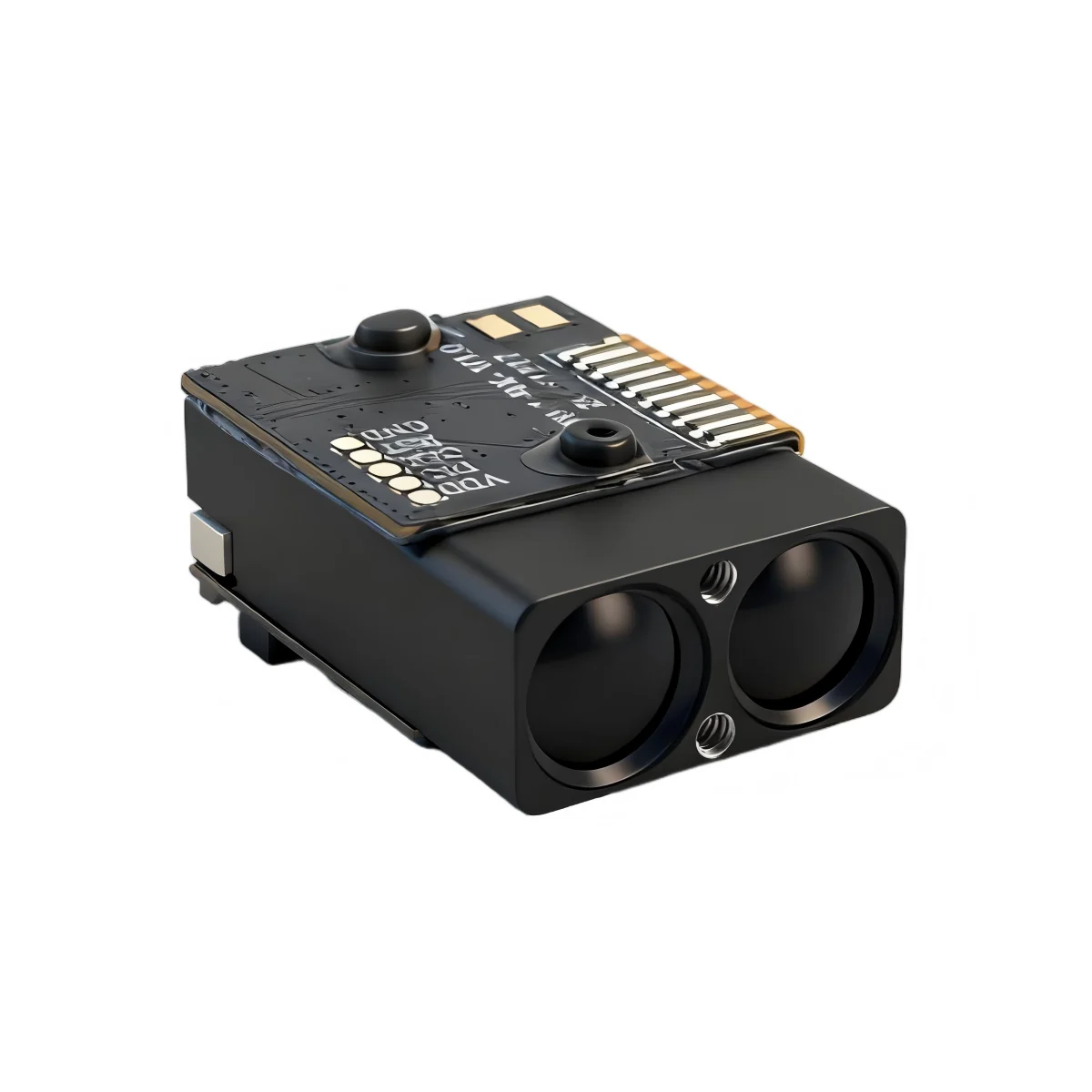
Both the SPD1200Z2 and the SPD1200N2 are 905 nm, UART-TTL modules with a 0.2–1,200 m source-table ranging distance. Per the current KB source tables the accuracy formula is identical for both models; the documented differences are in body dimensions, mass and the set of technical parameters that are confirmed in the current KB for each model. This article walks every row that differs—or where only one model has a confirmed value—so you can build your engineering checklist before requesting samples.
Same headline range, different source tables
Both source tables list 0.2–1,200 m as the ranging distance. Both modules also list up to 1,500 m at night under favourable conditions. Neither source table states the target reflectivity or visibility conditions that apply to the 1,200 m endpoint. That gap applies to both models equally; do not treat the headline figure as a guarantee against an arbitrary surface and do not borrow conditions from a different model in the catalogue to fill the blank.
The 905 nm UART module overview explains the general relationship between target reflectivity, visibility and effective range for this class of module. For either SPD model the applicable conditions for your scene must be confirmed with ERDI before design release.
Row-by-row comparison with conditions kept
| Row | SPD1200Z2 (current KB) | SPD1200N2 (current KB) | Note |
|---|---|---|---|
| Ranging distance | 0.2–1,200 m; up to 1,500 m at night | 0.2–1,200 m; up to 1,500 m at night | Reflectivity and visibility conditions not stated for either model’s 1,200 m endpoint |
| Ranging accuracy | ±0.3 m (d ≤ 100 m); ±0.3 m + d × 0.7‰ (100 m < d < 1,200 m) | ±0.3 m (d ≤ 100 m); ±0.3 m + d × 0.7‰ (100 m < d < 1,200 m) | Identical per current KB source tables; confirm source document revision with ERDI if the two models are expected to differ |
| Beam divergence | Not stated in current KB source table | <4.5 mrad | Z2 value requires direct engineering confirmation |
| Receiver aperture | Not stated in current KB source table | Ø 6.5 mm circular | Z2 aperture not confirmed in current KB |
| Body dimensions | 28.2 × 14.8 × 10.2 mm (rectangular) | 7.2 × 14.7 × 21.3 mm (square) | Z2 is ~7 mm longer; cross-section profiles differ — obtain the controlled drawing before machining |
| Weight | ≈6 g | ≤5 g | Module mass; bracket, cable and window add to installed mass |
| Measurement frequency | Source conflict: 2–15 Hz (overview) vs 2–20 Hz (table/section); not confirmed for publication | 2–15 Hz or 4–15 Hz adaptive; lower bound unresolved | Both carry source ambiguities; confirm delivered configuration with ERDI |
| Supply voltage | 3.3–5 V | 3.3–5 V | Identical; verify UART signal levels separately |
| Operating power | Average ≈0.45 W; max ≤0.75 W | Average ≈0.45 W; max ≤0.75 W | Identical |
| Operating temperature | −20 to +60 °C | −20 to +60 °C | Identical |
| Storage temperature | −30 to +70 °C | −30 to +70 °C | Identical per current KB source tables |
| Ingress protection | Not stated in current KB | IP67 (lens cavity) | Confirm Z2 rating with ERDI if sealing is required |
| Laser safety class | Not stated in current KB | IEC Class 1 | Confirm Z2 class with ERDI |
| Baud rate | Not reviewed for publication in current KB | 115200 bps (default) | Z2 rate and alternatives require the engineering datasheet |
| Pin assignments | Not reviewed for publication in current KB | Not in current KB spec table | Obtain the controlled drawing for both models before wiring |
Rows that are missing or ambiguous
The following fields are absent or carry unresolved source items in one or both models. Each is an open question for engineering confirmation before design release.
- Target reflectivity and visibility at the range endpoint. Neither source table states these conditions for the 1,200 m figure. Ask before comparing the headline range to a mission requirement.
- Ambient light immunity. No figure is stated for either model in the current KB. This matters for outdoor daytime use; leave the field empty rather than borrowing a number from a different model in the catalogue.
- SPD1200Z2 beam divergence, receiver aperture and ingress protection. These parameters are confirmed in the N2 KB source table (<4.5 mrad, Ø 6.5 mm circular, IP67 lens cavity) but are absent from the current Z2 KB source table. If window sizing, beam footprint or sealing requirements drive selection, request the controlled Z2 datasheet from ERDI to verify these values directly.
- SPD1200Z2 laser safety class. IEC Class 1 is confirmed for N2 in the current KB. The Z2 class is not stated in the current KB; request the applicable safety class documentation before specifying Z2 in a design with regulatory requirements.
- SPD1200Z2 measurement frequency. The Z2 KB records a source conflict between 2–15 Hz (overview) and 2–20 Hz (technical table and continuous-mode section) and leaves the field unconfirmed for publication. Confirm which bound applies to the delivered configuration before specifying a minimum update interval.
- SPD1200N2 measurement frequency lower bound. The N2 source formally retains both “2–15 Hz” and “4–15 Hz” as alternatives for the lower end. Confirm the delivered configuration before choosing a minimum update interval.
- Ranging accuracy formula. Per current KB source tables both models carry the same accuracy formula. If your analysis requires different accuracy specifications for the two models, ask ERDI to confirm the source document revision that applies to the delivered batch.
- Baud rate and pin assignments for SPD1200Z2. These fields are marked not reviewed for publication in the current KB. Obtain the full controlled datasheet from ERDI before wiring a harness or choosing an interface rate.
Which project constraints decide it
Match your documented constraints to the rows that differ. Mark each item with the evidence you have and the confirmation you still need.
- Body length is constrained. N2 (21.3 mm body length) is about 7 mm shorter than Z2 (28.2 mm), and uses a square cross-section versus Z2’s rectangular one. Obtain the controlled mechanical drawing for each before committing the mount or wiring harness routing.
- Beam spot size or optical path width is constrained. N2 has a confirmed <4.5 mrad beam divergence and Ø 6.5 mm circular aperture in the current KB. The equivalent Z2 values are not confirmed in the current KB; request the Z2 controlled datasheet from ERDI if these parameters affect window or baffle sizing.
- Ingress protection is a requirement. IP67 (lens cavity) is confirmed for N2 in the current KB. The Z2 rating is not stated; confirm the delivered Z2 protection class with ERDI before specifying it in a sealed assembly.
- Laser safety class must be documented. IEC Class 1 is confirmed for N2 in the current KB. The Z2 class is not stated in the current KB; request the applicable safety class documentation from ERDI.
- A specific baud rate or pin layout must match an existing harness. N2’s default baud rate (115200 bps) is confirmed in the current KB. Z2 baud rate and pin assignments are marked not reviewed for publication; obtain the engineering datasheet from ERDI before designing the interface layer.
- Accuracy at a specific distance is the binding requirement. Per current KB source tables both models carry the same accuracy formula. If your analysis requires a numerical difference between the two, ask ERDI to confirm whether different source document revisions apply before treating one model as more accurate than the other at any distance.
What to ask before ordering samples
Send these questions to ERDI engineering with the specific model number and the intended use case before releasing a design or placing a production order.
- What target reflectivity and visibility conditions apply to the stated 1,200 m ranging distance for each model?
- SPD1200Z2: what are the beam divergence, receiver aperture and ingress protection class for the delivered unit?
- SPD1200Z2: which measurement frequency bound applies to the delivered configuration (2–15 Hz vs 2–20 Hz)?
- SPD1200Z2: what is the default baud rate and are alternative rates available? What is the 6-pin connector assignment?
- SPD1200N2: is the lower measurement frequency bound 2 Hz or 4 Hz on the delivered unit?
- For both models: do they carry different accuracy specifications, or does the same source document revision apply to the delivered batch?
- What ambient light immunity applies to each model under the intended outdoor operating conditions?
The datasheet fields guide lists the full set of parameters to confirm before integration, including items not covered here such as UART frame format and valid-data flags. Bring your complete requirements and the answers to these questions to the ERDILRF contact page for an engineering review.
FAQ
Do both modules reach 1,200 m in bright sunlight?
Both source tables list 0.2–1,200 m and note that strong sunlight or low visibility may reduce range. Neither source table states the target reflectivity or visibility conditions that apply to the 1,200 m endpoint. Performance under bright sunlight depends on those conditions together with the target, geometry and optical installation. Confirm the applicable test conditions with ERDI before treating the headline figure as a bright-sunlight guarantee for either model.
Is the accuracy the same across the whole range?
Per the current KB source tables, both models carry the same accuracy formula: ±0.3 m at or below 100 m, then ±0.3 m + d × 0.7‰ above 100 m up to 1,200 m. The source tables do not state a numeric target reflectivity for this claim. If your analysis depends on a numerical difference in accuracy between the two models, ask ERDI to confirm which source document revision applies to the delivered batch before treating one model as more precise than the other at any distance.
Which documents should I request before integration?
Request the current controlled PDF datasheet for the specific model, the mechanical drawing with the delivered connector variant, and the electrical interface document confirming UART signal levels. For SPD1200Z2, ask for the beam divergence, receiver aperture, ingress protection class, confirmed measurement frequency bound, default baud rate and 6-pin connector assignment. For SPD1200N2, ask for the confirmed lower frequency bound (2 Hz or 4 Hz). For both models, ask which accuracy source document revision applies to the delivered batch. Record the document revision number and confirm it matches the delivered production batch before releasing the design.
Category pages: Laser rangefinder module
Models mentioned in this article
- SPD1200Z2905 nm · up to 1.2 km · UART · TTL · ≈6g1 pc $150 · shipping includedSee price & buy
- SPD1200N2905 nm · up to 1.2 km · UART · TTL · ≤5 g1 pc $90 · shipping includedSee price & buy